A Wonky Lamp, a Tea Urn and a Room Full of Quiet Experts
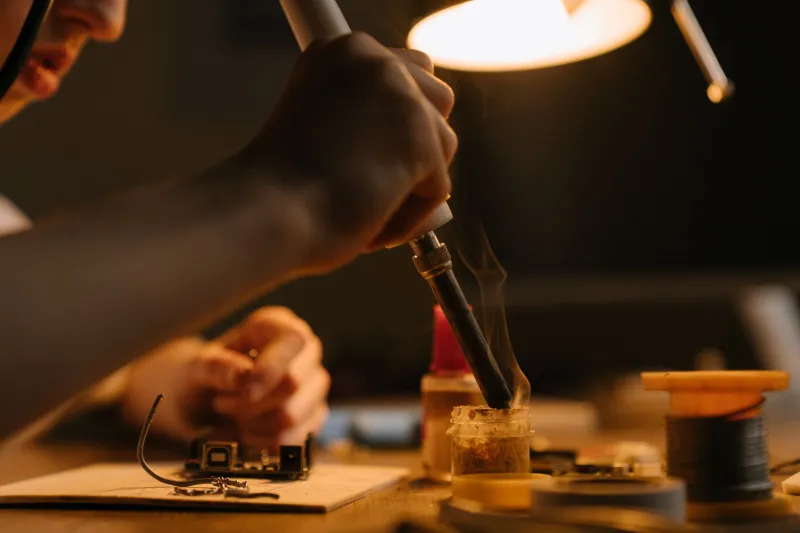
The lamp has been wonky since March. Not dramatically wonky — no sparks, no smoke — just a switch that needed jiggling twice, then three times, then a firm word before it would concede. We kept meaning to deal with it. We also kept using it, which is the British way.
Then a neighbour mentioned the repair café at the village hall. First Saturday of the month, 10 till 1, bring anything that's broken and a bit of patience. So we unplugged the lamp, wrapped it in a tea towel like a poorly hen, and drove the four minutes into town.
The queue, the ticket and the tea urn
We arrived at 10:07 and were already number 14. A folding table by the door had a roll of raffle tickets, a cash tin and a laminated sign: 'PLEASE TAKE A TICKET'. A woman with a lanyard asked what we'd brought. 'A lamp,' Joe said. 'Switch,' Holly added. She nodded as if we'd said something medically significant and wrote 'lamp — switch/flicker' on a clipboard.
The hall smelled of instant coffee, warm dust and the particular rubbery scent of old electricals. There were eight or nine tables arranged in a horseshoe: sewing machines at one end, bikes at the other, and in the middle an archipelago of toasters, radios, kettles and one hedge trimmer that looked like it had lost an argument. A tea urn burbled on a trestle table near the kitchen hatch. Fifty pence a cup, cake a pound. We paid in coins and sat on plastic chairs to wait.
This, we quickly realised, was not a drop-off service. You stay with your item. You explain its symptoms. You hold the torch. You learn things.
What was actually wrong
When our turn came, a retired electrician called Ron took the lamp with both hands like a christening. He turned it over, peered at the plug, and asked the questions we should probably have asked ourselves. Has it always flickered? Just the one bulb? Did you try a new bulb? (We had. Twice. Then we'd blamed the bulb anyway, because hope is cheap.)
Ron unscrewed the plug and found the answer in about ninety seconds: a loose wire, barely held by a screw, and a fuse that had been living on borrowed time. 'Not dangerous,' he said, 'but not happy either.' He stripped a fresh quarter-inch of cable, re-terminated the wire, fitted a new fuse from a tin that rattled like a maraca, and tested it with a small grey gadget. The lamp came on first time. No jiggle. No firm word. Just light.
The whole thing took eleven minutes. We'd spent longer choosing a cake.
The quiet experts
What we hadn't expected was the theatre of the room. Beside us a teenager was being taught to thread a sewing machine by a woman in a WI apron. At the far table a man with a magnifying glass was explaining to a queue of six why a toaster had 'gone to the great crumb tray in the sky' and why that was actually fine. Nobody was being told off. Nobody was being sold anything. The only currency was attention.
There's a particular sort of person who volunteers at these things — patient, mildly obsessive, allergic to waste — and the repair café gives them somewhere to put it. Ron told us he'd spent forty years as an electrician and now fixed 'about six lamps and a lawnmower a month' because 'it beats sitting in front of the telly shouting at the news'. Another volunteer, mending a bike brake, said the best part was when someone came back the next month with something else. 'That's when you know you've got them,' she said. 'They stop thinking of broken as the end.'
Practical notes if you go
A few things we wish we'd known before we turned up:
- Take the whole item. Not just the bit you think is broken. Bring the plug, the cable, the bulb, the instruction booklet if you have it. The more clues, the better.
- Expect to wait. The queue is part of it. Take a book, or better, talk to the person next to you. We met a man who'd brought a 1970s radio and a story about his dad. The radio was fixed. The story was free.
- Be honest about what you know. 'It's making a noise' is a symptom. 'I took it apart and there was a small spring left over' is a diagnosis. Both are useful.
- Bring cash and small change. Tea, cake, and sometimes a donation tin for parts. Ours was a fiver into the tin and a slice of lemon drizzle.
- Know when to stop. Not everything can be saved. The toaster man was very clear on this. The trick is to find out before you spend forty minutes on it.
- Check your local library or community noticeboard. Repair cafés pop up in church halls, scout huts and libraries. Some are monthly, some quarterly, some run by a single bloke with a shed and a rota. All of them need volunteers, so if you're handy, offer.
What we brought home
The lamp works. It's been working for two weeks now, and every time we switch it on we do a small, silent thank you to Ron and his tin of fuses. But the lamp wasn't really the point.
We went in expecting to learn about wiring and came out thinking about thrift, and patience, and the strange warmth of a room full of people refusing to throw things away. The repair café is a small, quiet kind of optimism: the belief that most things can be mended, that someone nearby knows how, and that a cup of tea makes the waiting easier.
We've already started a bag for next month. A kettle with a dodgy switch, a pair of jeans with a split seam, and a radio that's only slightly haunted. If you see us in the queue, say hello. We'll be the ones with the flask, just in case the urn runs dry.