Three Pieces Short: The Charity-Shop Jigsaw That Built a Sunday Table
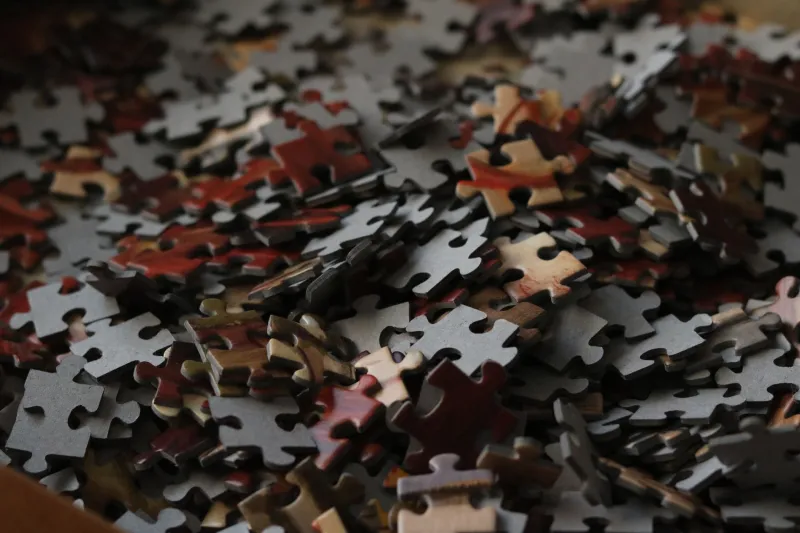
We bought it on a wet Saturday in November, mostly because the charity shop window was warm and the box was £2.50. On the lid, a cottage garden in improbable full bloom; inside, a thousand pieces and the faint smell of someone else's loft. We didn't check it. You never do, do you?
The jigsaw that came with homework
For two weeks it lived on the dining table, spreading like weather. Joe did the sky in one long, stubborn sitting. I did the bits of hedge and the wonky gate. We ate dinner on our knees and kept saying we'd clear it away tomorrow. Then, somewhere near the end, we noticed the gaps.
Not one missing piece. Three. Numbers 27, 418 and 902, if the box was to be believed. We checked the floor, the hoover bag, the pockets of Joe's coat. Nothing. The puzzle was short, and somehow that made it better. It had a story now, and a small, tidy mystery.
So we wrote a note on the back of an old shopping list: Three pieces short — 27, 418 and 902, if anyone's counting. Sorry. H. We put it in the box, fastened the lid with an elastic band, and left the whole thing on the book-swap shelf by the village hall with a sticky label that said: Borrow me. Bring me back.
We expected nothing. A fortnight later, the box was back, with a second note tucked inside.
Found one under my radiator. No idea how it got there. M.
A box with a conversation in it
That was the beginning, though we didn't know it then. Margaret from the end of the terrace had borrowed the jigsaw for her granddaughter. The piece had turned up behind a radiator when they moved a chair. She thought we'd like to know. We thought it was the best thing we'd heard all week.
By the middle of December, the box had been borrowed four more times. Each return came with a scrap of paper: a tally of pieces, an apology for a slightly bent tab, a recommendation for another charity-shop puzzle. One neighbour, Sheila, added a small drawing of the missing piece 418 so we'd recognise it if it ever turned up. It looked like a bit of sky with a smudge of cloud.
By January, someone had left a second jigsaw beside it. Then a third. The book-swap shelf was becoming a puzzle library, and the village hall committee — who are lovely and quietly efficient — asked if we'd like to use the small room on Sunday afternoons. Not a club. Just a table.
The rules of a borrowed jigsaw
We learned the etiquette as we went along, mostly by getting it wrong. Here is what we'd pass on.
Count nothing at the start. A missing piece is not a crisis; it is a conversation waiting to happen. If you must count, do it silently and with a biscuit nearby.
Never force a piece. If it needs a firm hand, it is the wrong piece. This applies to jigsaws and, frankly, to most things.
If you borrow a puzzle, return it with a note. Not a long note. Just enough to say what happened. We have had notes about cats, leaky roofs and one marriage proposal. The jigsaw is incidental.
Do not take a piece home for safekeeping. We did this once, with a piece that looked like a bit of chimney. It caused a diplomatic incident involving a shortbread tin and a very patient neighbour. The piece came back in an envelope with a stern but fair note.
And if a piece is missing, say so cheerfully. A jigsaw with a gap is not a failure. It is a jigsaw with a personality.
A table, not a club
Sunday afternoons at the village hall are not organised. There is a tea urn, a tin of biscuits, and a honesty box that says 50p a mug. Someone brings a lamp. Someone else brings a folding chair. People arrive when they arrive and leave when they leave.
We have had a retired teacher, two teenagers, a man who does the edges and nothing else, and a small girl who likes to put all the pieces into colour groups and then abandon them. Nobody minds. The jigsaw gives everyone something to do with their hands, which makes talking easier. It is a low-stakes way to be in a room with other people.
That is the thing we didn't expect. The puzzle was never really about the puzzle. It was about the note in the box, and the radiator, and the fact that a borrowed box can say: I was here. I noticed. I thought you'd like to know.
What the gaps taught us
The three missing pieces never all turned up. One arrived in an envelope in March: Found in the cutlery drawer. No questions. The other two remain at large. We have stopped looking.
Joe says the missing pieces are a design feature. I think he is right. A jigsaw with a gap is a conversation that hasn't finished. You can't tidy it away completely. You have to leave it out, and see who comes to the table.
If you're staring down a dark November and fancy a small, cheap adventure, buy a second-hand jigsaw. Check the box. Write a note. Leave it somewhere someone else might find it. You might end up with a weekly table, a biscuit rota and a street that knows each other a little better. Three pieces short, and all the better for it.